
Compare Anderson County Property Value Types
Name the number before anything else. Kentucky's PVA system assesses real property at estimated fair cash value, while qualifying farmland can move to a separate agricultural valuation. A homestead exemption can change the taxable figure. And the consideration written into a deed marks a transfer that may not be arm's length.
| Value type | What it means | Where recorded |
|---|---|---|
| Assessed value | The PVA value used in the assessment system | PVA roll |
| Fair cash value | Kentucky's general real-property valuation standard | PVA assessment context |
| Taxable value | The amount remaining after applicable treatment or exemption | PVA and tax record |
| Last sale or consideration | A figure tied to a recorded transfer, subject to exceptions | Deed and possible sales history |
None of this means a record is wrong. Values tied to different events and purposes can diverge, so compare the year and the definition before treating two figures as proof of change.
Look Up an Anderson County Assessed Value
The Anderson County PVA qPublic landing page offers search by owner, address, or parcel. Enter the stable parcel identifier. Save the assessment year shown with each result. Field options on the live page may vary, so rely on the parcel number rather than any single search format.
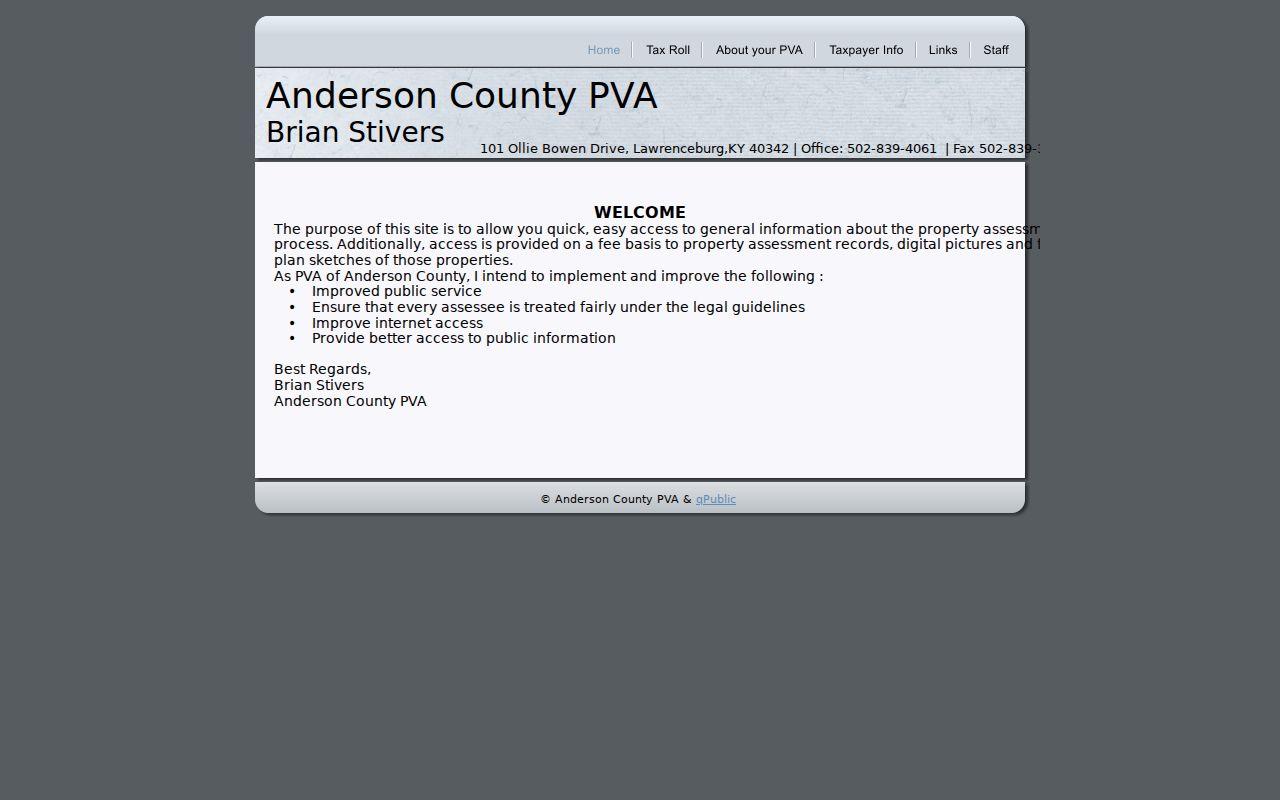
The landing page identifies the PVA's local gateway. The parcel result itself supplies the value labels and assessment year to copy for comparison.
- Open the Anderson County PVA / qPublic landing page.
- Search by situs address, owner, or parcel, using the options the live page provides.
- Confirm the parcel with its address and legal-description clues.
- Copy each value label exactly and record its tax year.
- Check the latest deed only if a transfer figure is needed for comparison.
- Assessed value
- The value carried in the PVA assessment record.
- Market or fair cash value
- The estimated price property would bring at a fair voluntary sale under the state standard.
- Assessment ratio
- The relationship between an assessed amount and the value standard applied.
- Consideration
- The transfer figure stated for covered deeds, with statutory exceptions.
- Reassessment
- A later valuation of property for the tax roll.
Kentucky's Fair-Cash Standard Shapes Anderson County Values
The Kentucky Department of Revenue explains the standard plainly. Real property is assessed at estimated fair cash value. That is a tax-administration measure, not a forecast of what a buyer will pay. The PVA uses mass-assessment methods across many parcels. It does not produce a private appraisal for one transaction. Treat any figure as a benchmark with a stated year. Physical condition, sale terms, and market timing can all pull a real deal away from the assessed number. Features the roll has not yet absorbed can too. A purchase or sale that needs a current opinion belongs with a qualified appraiser.
The Four-Year Inspection Rule in Anderson County
Kentucky requires a physical inspection of each parcel at least once every four years. That is a cycle, not a value lock. Values do not change only once per cycle. New construction, property changes, annual roll work, or other facts can move an assessment at any time. A fresh closing will not hit the roll overnight. Anderson County publishes no fixed update lag. When a property just changed hands, pair the assessment year with the latest recorded deed date.
Agricultural Value Follows a Different Anderson County Track
Kentucky lets qualifying farm land take agricultural valuation rather than ordinary fair-cash treatment. So a farm parcel's tax-oriented number can look unlike a simple market comparison. Read the classification. Note the land treatment. Only then compare it with a home parcel or a development tract. Never infer acreage value by dividing the total assessment. Improvements, land classes, exemptions, and agricultural treatment each shape the displayed totals. If the public result stays unclear, ask the PVA. Ask which field reflects land, improvements, or special classification.
Why Anderson County Assessed and Taxable Values Diverge
Kentucky's homestead and disability provisions can reduce the amount subject to tax for eligible applicants. The underlying value stays put. A reduced taxable figure is not a sale estimate either. Keep the gross assessment and the exemption-adjusted figure separate. Filing and appeals belong on the property-tax page. For this comparison, note whether a reduction explains the gap, then use the Anderson County property tax records guide for the tax-bill path.
Read Anderson County Deed Consideration Carefully
KRS 382.135 requires a statement of consideration or market value in covered deeds, along with mailing or in-care-of information, subject to exceptions. A deed figure can be nominal. It may mark a gift. It may reflect a court action or exempt instrument rather than an open-market sale. Read the instrument and its transfer-tax notation before calling the number a sale price. Check any PVA sales-history figure against the recorded document. Its date and parcel description should match. A newer deed can post before the tax roll changes, so recording and assessment can each be accurate for their own dates while showing different names or values.
What an Anderson County Property Value Cannot Prove
An assessed value proves no boundary. It reveals no condition, title, or offer. GIS geometry answers a map question, the tax roll answers an assessment question, and a deed records a conveyance. Blend those numbers into one conclusion and the conclusion is unsupported. A value also cannot reveal why it changed. Ask the PVA whether the year reflects new construction, a physical inspection, classification, or routine roll work before crediting the market alone.
Value is not price. An Anderson County assessed value supports taxation; it is not a current appraisal or a promise of what the property will sell for.
Compare Anderson County Values on the Same Date Basis
A value comparison collapses fast. Set one parcel's fresh assessment beside another parcel's stale sale price, and the numbers stop meaning anything. Build a small worksheet first. List the parcel ID, the assessment year, and the assessed value label. Add any special classification, exemption status, transfer date, stated consideration, and the source. Now you are comparing like with like. When the years differ, say so plainly. Do not compute a precise change the records cannot back up.
Some assessment systems break land and improvements apart. The live Anderson qPublic inventory does not expose that split. If a search returns only a total, the PVA can still help. It can say whether public detail exists online, at the office, or through a fee-based assessment product. The older qPublic landing page separates free general information from fee-based assessment records, pictures, and floor plans.
Nearby assessments add context. They are not automatic comparables. Parcel size, farm classification, building type, condition, and effective year can all differ. Treat surrounding figures as a prompt for a question to the PVA or an appraiser. Never treat them as a declaration of market value.
Date Every Anderson County Property Value Source
The PVA roll, a recorded deed, and a tax collection record each move on its own calendar. Bills go out at the end of September. Collection opens October 1, and inspection and appeal events follow the state property-tax calendar. A recorded conveyance can be newer than any of them. Note the date the source itself displays and the date you accessed it.
That habit matters most after a recent closing. One administrative screen may still show the seller while eCCLIX already carries the buyer's deed. Anderson County publishes no exact owner or value update lag, so none should be inferred. The PVA can confirm which assessment year controls a given number. The Clerk can identify the latest recorded transfer document.
Kentucky's inspection period opens on the first Monday in May. It runs thirteen days, including two Saturdays. That fact places an assessment inside its review cycle. Conference and appeal mechanics, though, belong with property tax records rather than the value itself.