
Reading an Anderson County Current Owner Card
Every current owner check begins at the Anderson County PVA qPublic landing page. Its assessment roll ties an owner name to a parcel for tax administration. That is exactly what an owner search needs. The site offers owner, address, and parcel search options. Treat whatever it returns as an administrative record. After a recent closing, back it up with the newest deed recorded by the County Clerk. Check that before trusting the name.
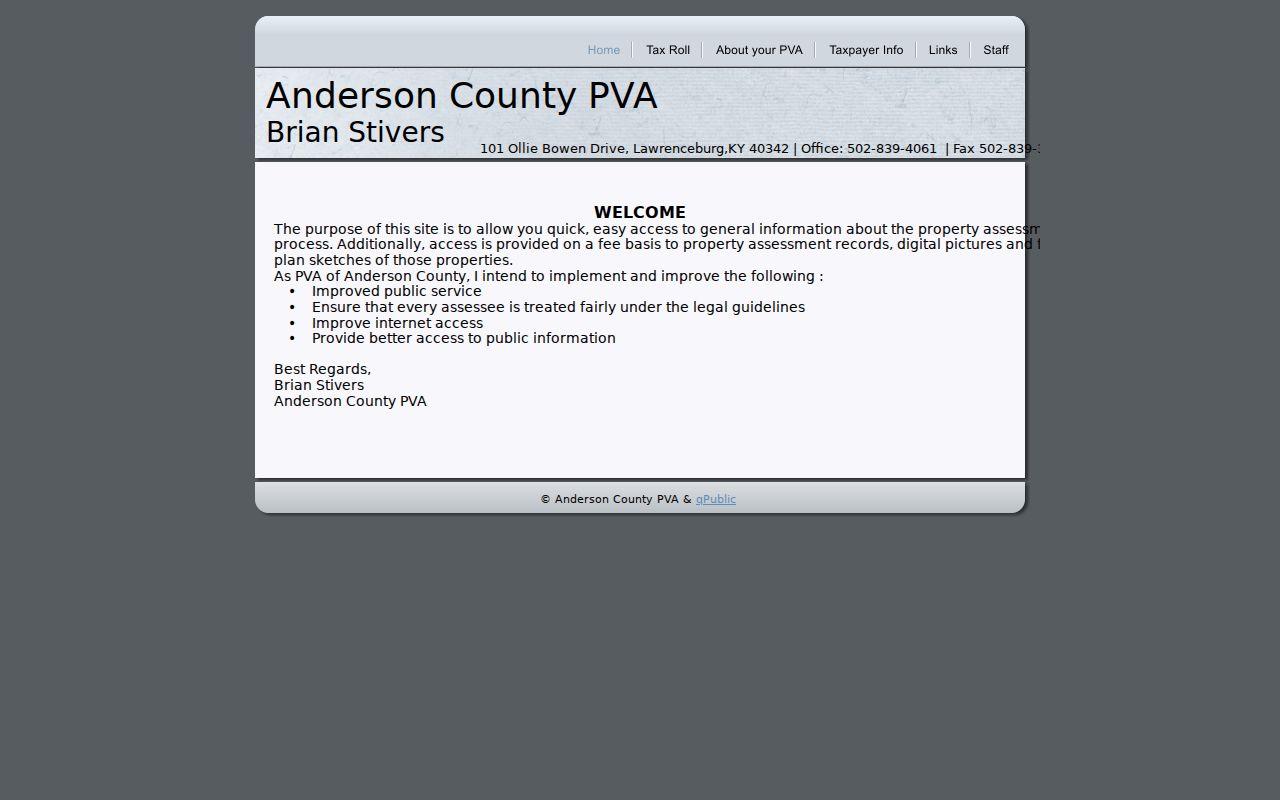
The PVA page itself is just the entry point. It points you toward the live assessment record, which still needs to be read against the newest County Clerk deed.
| Owner name | The person or entity carried on the PVA roll. |
|---|---|
| Mailing address | The destination used for notices; it may differ from the property. |
| Situs address | The physical property location used to find the parcel. |
| Parcel identifier | The stable key for matching the roll to maps and deeds. |
| Deed reference | A book, page, or document clue pointing to the recorded transfer. |
| Sale or transfer date | A timing clue that should be checked against the deed image. |
An owner of record is not always the person living in the house. The mailing address on file might be a post office box. It could also be an address in another county, or an in-care-of line. That works fine for lawful property correspondence. It proves nothing about residence. The current owner label can also belong to an LLC, a trust, or an estate rather than a named individual. So read the field literally.
When Anderson County's Owner Roll Lags a Deed
A recorded deed and the PVA roll update on separate tracks. Kentucky requires the PVA to maintain assessment records. The office must also physically inspect each parcel at least once every four years. That rule says nothing about next-day ownership changes after a closing. Anderson County publishes no fixed lag interval. So when a sale is recent, compare the PVA result with the newest eCCLIX entry. Write down both dates. The latest deed is the stronger proof that a conveyance was actually recorded. The PVA entry still earns its keep for tax administration. It also covers parcel identity and the mailing address on file. When the two disagree, resist the urge to guess. Ask the County Clerk to confirm the newest recorded instrument. Then ask the PVA to explain its roll timing. Tax-year timing can also make two valid checks look inconsistent. Save the deed date, the recording date, and the assessment year. Those labels reveal whether your comparison straddles two reporting cycles. The four-year inspection rule governs parcel review, not the pace of an owner-name change. It cannot stand in as an update schedule.
Use the Latest Anderson County Deed as the Check
The Anderson County Clerk recording page states that permanent records are available online through eCCLIX. Private citizens may search Anderson County records free of charge, subject to a five-search-per-day limit. No earliest online year is published. So the service cannot be called a complete historic chain of title. Search the apparent buyer as a grantee and read the newest relevant deed. Match the parcel's legal description, source-of-title reference, mailing information, and book/page or document number. Kentucky law requires specified deeds to carry immediate source-of-title information. In covered transfers, the law also requires a statement of consideration or market value. A matching name alone settles nothing when two people share it.
Confirm the Anderson County Current Owner
Work from the tax roll to the recording record in a fixed order. That discipline keeps the owner-of-record question narrow. It also makes a recent transfer, entity name, or mailing mismatch easier to spot.
- Search the Anderson County PVA / qPublic by the address, owner, or parcel identifier.
- Copy the owner spelling, parcel ID, situs, mailing address, and any deed clue shown.
- Search eCCLIX for the newest deed naming that owner as grantee, then match the legal description.
- If an LLC owns the parcel, check the Kentucky Secretary of State entity file for its registered agent and current filings.
- Contact the Clerk or PVA when dates or names conflict instead of treating either screen as conclusive.
- Owner of record
- The party named as owner in the public record being consulted.
- Vesting
- The words in an instrument that state who takes title and in what capacity.
- Tenancy
- The legal form in which two or more people hold an interest.
- Registered agent
- The contact designated in a business entity's state filing.
Checking an Anderson County LLC Owner
When the current owner is a company, copy the business name exactly as it appears on the PVA roll and the deed. The Kentucky Secretary of State business search works by name or organization number, with a separate officer, member, and manager search. Annual reports change over time. So compare the entity record's status and filing dates with the deed date. A registered agent is a service contact, nothing more. The agent neither owns nor occupies the land. A trust label may name a trustee while saying nothing about the beneficiaries. For an estate, the deed trail and any probate file can show how title moved, but the task here is simpler: verify the name now vested.
Why Anderson County Mailing and Situs Lines Differ
Two addresses can sit on one Anderson County parcel record. The situs address tells you where the land sits. The mailing address tells you where the owner of record gets tax bills and notices. Around Lawrenceburg, those lines disagree for another reason. The postal city name, the legal city boundary, and the physical description of the parcel can all point in different directions. A post office box or an out-of-county mailing line is common and normal. It is never proof that the PVA named the wrong owner.
Resolve the land itself first. Use the parcel number and the legal description, not the mailing line, to pin down what you are looking at. For a boundary question at the city's edge, Kentucky Secretary of State annexation filings and certified plats can show whether land sits inside Lawrenceburg. Its mailing address may say otherwise. That quirk matters for permits and zoning. It does not change the name the deed vests.
If you write to an owner lawfully, address the letter to the exact name on the roll. Use its mailing line. Put the parcel address in the subject line too. That way an owner holding several Anderson County parcels can tell which property you mean. Returned mail does not prove a sale happened. It only means the contact route deserves a second check with the PVA.
Watch Anderson County Owner Filings With DocAlert
The Clerk's recording page advertises DocAlert, a county-linked notice service covering deeds and mortgages. Enrollment takes little effort. You supply a name or business name plus an email address. When a matching filing gets recorded, the service sends an alert straight to you.
This step works best after the current owner has been confirmed. Enter the owner's name exactly as recorded instruments spell it. Add the business name too where an entity holds title. Treat each alert as a prompt to pull the document at the Clerk's office, never as proof that a filing is valid or that ownership changed.
Contacting an Anderson County Property Owner Lawfully
The tax-roll mailing line gives the public a lawful route for property-specific correspondence. Write to the owner of record about a boundary. A possible purchase, an easement, or shared maintenance can also be fair reasons to write. Keep expectations modest. A mailing address is not always a home address. Open records do not license publishing personal details.
Save a copy of the parcel ID. Note the source date and the exact mailing label you used. That small record keeps later follow-up clear if the PVA updates a name or address.
Kentucky Safe at Home can substitute and mask addresses in many government records. State compliance guidance, though, says real-estate holdings stay excluded and remain public. That exclusion does not grant permission to misuse what the roll shows. For more on tracing ownership, see the Anderson County owner-finding guide.
Lawful use. Public owner data may support property diligence and civil contact. Never use it to stalk, harass, threaten, or harm anyone.