
Read Anderson County Property Tax Records
Two linked records make up the Anderson County tax file: the Property Valuation Administrator, or PVA, sets each parcel's assessment and tracks exemptions. The Sheriff collects the yearly bill. After April 15, an unpaid bill becomes delinquent. The County Clerk then runs the certificate sale. Keeping the three stages straight prevents a paid assessment record from being mistaken for a current tax balance.
| Tax field | Meaning | Official keeper |
|---|---|---|
| Fair cash value | The PVA's estimate of full property value for assessment purposes | Anderson County PVA |
| Taxable assessment | The value used after any qualifying exemption or farm treatment | Anderson County PVA |
| Bill and payment status | Amount billed, discount or penalty period, and collection status | Anderson County Sheriff |
| Delinquent certificate | Unpaid tax claim transferred after the Sheriff's collection period | Anderson County Clerk |
| Taxing jurisdiction | County, school, city, or other rate components tied to the parcel | PVA and tax bill |
A tax assessment is not a deed price. Kentucky law expects real property to be assessed at estimated fair cash value, while qualifying agricultural land may receive agricultural valuation instead. A deed may report consideration under recording law. Gifts, court transfers, and exempt instruments do not always reflect an open-market sale. So the numbers answer different questions. Compare the PVA record, the bill, and the recorded instrument before drawing any value conclusion.
Anderson PVA Values Start the Tax Trail
The Anderson County PVA qPublic page anchors the tax trail. It opens with owner, address, and parcel lookups. It also adds links for duties, appeals, exemptions, and a tax calculator. A second Schneider endpoint exists for newer searches. Its live fields and earliest online year are not listed publicly. When the portal stalls, the PVA office can help. The office sits at 101 Ollie Bowen Street in Lawrenceburg and takes calls at 502-839-4061.
Assessment data serves the tax roll first. A lookup can tie an owner of record to a parcel and a value. But a deed recorded right after closing may lag until the next roll update. Kentucky law calls for a physical inspection of every parcel. It must happen at least once each four years. That cycle sets the inspection schedule, not the pace of record changes.
For assessment access, start with the Anderson PVA landing page.
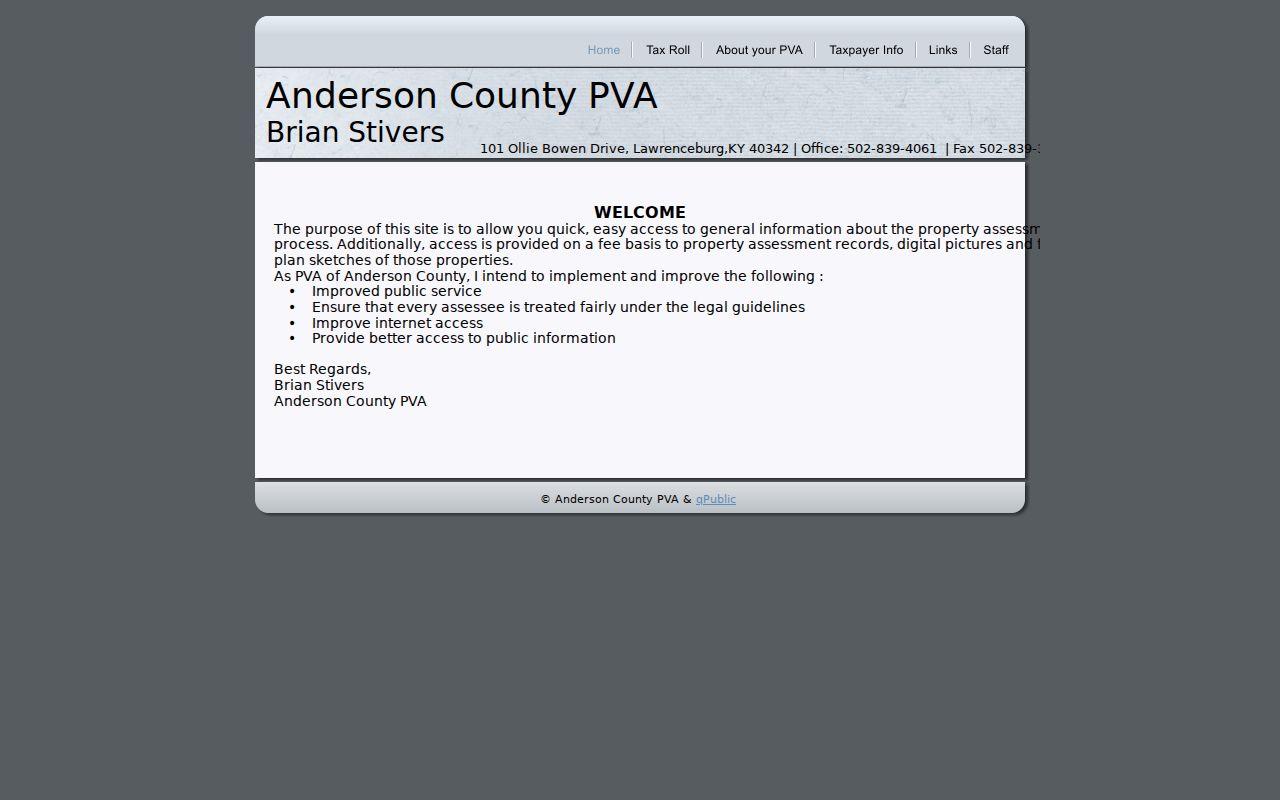
The qPublic page splits general data from paid detail.
Note: Record the parcel number and assessment year because owner names and values can change between tax cycles.
The Anderson County Tax Collection Calendar
Anderson County taxes follow a yearly rhythm. Bills go out near the end of September, and collection opens October 1. Pay through November 1 and earn a 2% discount. Face value runs through December 31. January adds a 5% penalty. From February 1 through April 15, the bill carries a 10% penalty plus a 10% sheriff add-on. Then the calendar changes hands. After April 15, unpaid certificates pass from the Sheriff to the County Clerk, so current collection questions go to the Sheriff while transferred delinquencies and later certificate-sale steps go to the Clerk.
Use the Sheriff-Linked Anderson Tax Lookup
The Sheriff's tax-collection page links to the official bill-viewing service. Open the Sheriff-linked property-tax lookup from there. Enter the information the live portal accepts. Then match the returned parcel to the PVA record. Check the tax year as well. Do not assume every year or name format is available.
The image shows the public entry point. Confirm the tax year, parcel identity, amount, and payment state rather than trusting a search-result label alone.
Look Up an Anderson County Tax Bill
Start every lookup with the parcel number. Moving from identity to assessment to collection status keeps similarly named owners and repeated street numbers from being confused.
- Find the parcel through the Anderson PVA search by owner, address, or parcel number. Save the parcel identifier and the assessment year.
- Follow the Sheriff's tax link and match the bill to that identifier. Check the displayed year and collection status.
- Return to the PVA roll to see whether a homestead, disability, or agricultural treatment affects taxable value.
- If the bill passed April 15 unpaid, check the County Clerk's delinquent-tax page and contact the Clerk for certificate status.
- Assessed value
- The PVA value placed on property for tax administration.
- Levy or tax rate
- The rate applied by a taxing authority to the taxable assessment.
- Homestead exemption
- A reduction available to qualifying Kentucky homeowners who are age 65 or older or totally disabled.
- Tax lien
- A legal claim tied to unpaid property tax; a delinquent certificate carries rights and risks defined by law.
Anderson Homestead, Disability, and Farm Value Rules
The Kentucky homestead exemption stands at $49,100 for the 2025 and 2026 assessment years. Homeowners age 65 or older qualify. So do people classified as totally disabled under a qualifying program. The Anderson County PVA handles eligibility and filing. The Sheriff's payment portal does not. Farm land can qualify too. Kentucky permits agricultural value instead of ordinary fair cash value treatment, which can leave the taxable assessment far below a casual sale estimate. Ask the PVA which classification and exemption fields apply to the parcel before treating the bill as a market-value report.
Note: An exemption lowers taxable value when approved; it does not rewrite the deed price or establish a new market sale.
Anderson's 2026 Delinquent Certificate Sale
The Anderson County Clerk delinquent-tax page reports that 2025 certificates transferred from the Sheriff. That transfer happened on April 15. Taxpayers could avoid a third-party sale through August 20, 2026. The sale venue has moved to the Anthony D. Stratton Building at 1026 County Park Road. The record set keeps changing. Weekly pre-sale list updates, purchaser registration, and required 30-day and 60-day notices all reshape it. Review the current Clerk sale page for the latest posting.
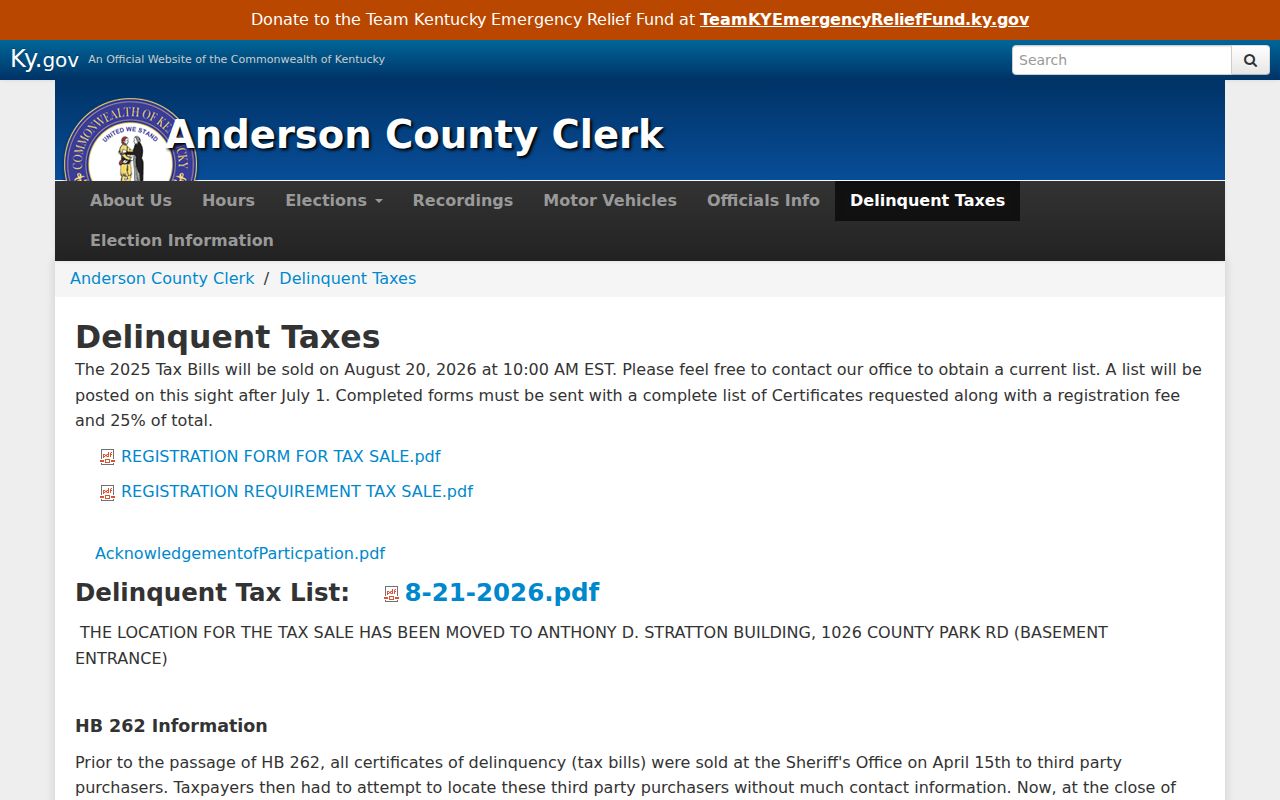
A dated downloaded list is only a snapshot. Recheck the current posting and contact the Clerk before acting on any certificate entry.
Counter and Phone Access for Anderson Tax Records
Walk-in service still matters in Lawrenceburg. The Anderson County PVA, at 101 Ollie Bowen Street, answers parcel-value, exemption, and assessment questions. The Sheriff at 208 South Main Street collects the current tax bill, and its tax phone number sits on the collection page. The County Clerk at 100 South Main Street takes over after delinquency transfer. Bring one parcel number. That number carries an owner through assessment, payment, and delinquency.
Sheriff hours run 7:00 a.m. to 5:00 p.m. weekdays. Check, cash, and money order are accepted. Partial payments are not. A mailed payment is not timely just because of its postmark. Mailed bills no longer go to mortgage companies. An owner whose lender pays from escrow should still confirm the parcel, year, and payment state. Those rules govern collection only; a wrong value or exemption stays with the PVA.
Delinquency changes the custodian and the charges. After the April 15 transfer, the Clerk's process adds a 20% County Attorney fee, a 10% Clerk fee, and 1% monthly interest under county guidance. A third-party purchaser may later acquire the certificate. That is not a deed sale. Ask for the certificate year, the current holder, payoff figures, and the most recent official list. An old sale notice is not current status.
A focused request works best for records not online. Name the parcel, the tax year, the document wanted, and the copy format. Kentucky's Open Records Act overview explains access to nonexempt public records, while confidentiality rules and privacy exemptions can limit what an office releases.
Contest an Anderson County Assessment
Kentucky's statewide property-tax calendar opens the tax roll for inspection on the first Monday in May. The window runs thirteen days and includes two Saturdays. First, the owner conferences with the Anderson County PVA. If the dispute survives that talk, the appeal goes to the local board, filed with the county clerk by close of business one workday after inspection ends.
Good evidence covers the parcel's physical facts, cost information, insurance material, listings, and comparable properties. Argue the assessment as of the relevant date. A bill-payment issue belongs with the Sheriff or Clerk. It never changes the PVA value. Read the official Kentucky appeal calendar before the window closes.
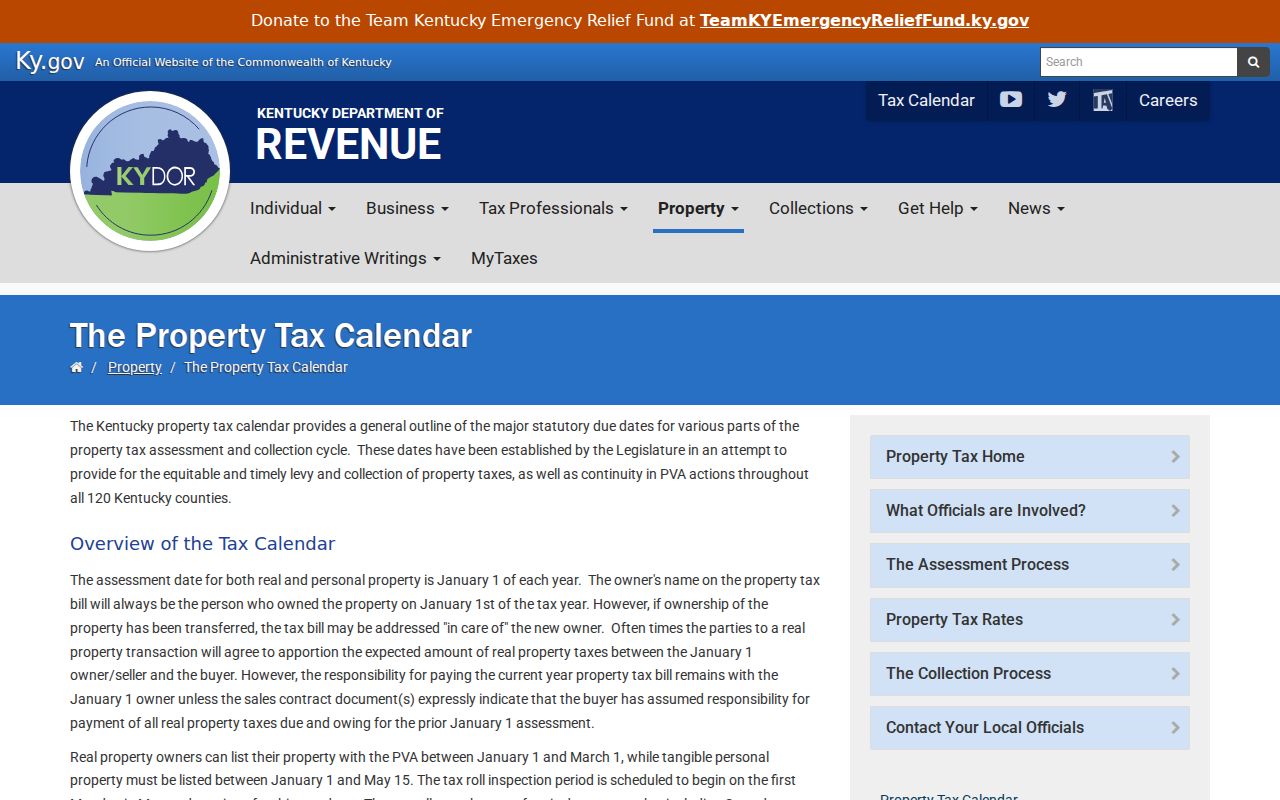
It confirms the required PVA conference and filing window.
Appeal window. Conference with the PVA during open inspection, then file with the county clerk no later than one workday after that period closes.