
Build an Anderson County Former-Owner Timeline
Give every transfer its own row. Start with the newest Anderson County deed and copy the grantor, grantee, instrument type, transfer date, and book and page reference exactly as recorded. A tax roll name change is only a clue. Gifts, estate settlements, court orders, and parcel splits can shift the sequence in ways that never resemble an ordinary sale. A careful timeline keeps those distinctions visible.
| Transfer point | Grantor to grantee | Instrument | Clerk reference |
|---|---|---|---|
| Newest | Current seller to buyer | Type stated in deed | Book/page or document |
| Prior | Earlier seller to later seller | Type stated in deed | Source-of-title citation |
| Older book era | Names copied from volume | As written | Volume and page |
| Supporting clue | Tax, plat, estate, or notice | Not a deed substitute | Its separate citation |
Keep the legal description beside every row. Streets get renamed, and parcel IDs shift after splits or combinations. The land description itself is the best defense against attaching a same-name deed to the wrong Anderson County tract.
Anderson County Publishes No eCCLIX Cutoff Year
The Anderson County Clerk states that permanent records are available online through eCCLIX. A local access page adds that private citizens may run a free Anderson County search. It is capped at five searches per day. Neither page names the earliest indexed year. Ask the Clerk directly where the searchable run ends. Until then, treat any online result as part of a chain, not the whole one.
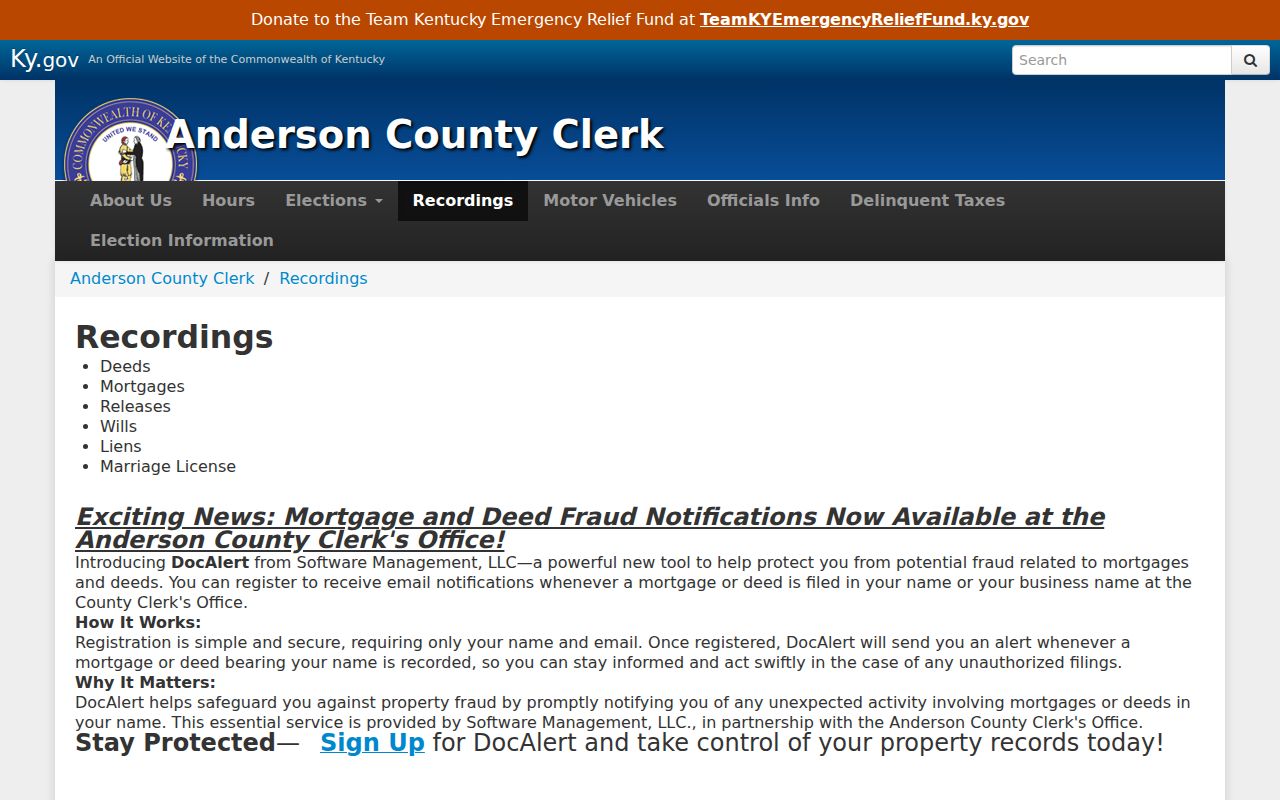
The Clerk page confirms the recording categories and the online route that starts the backward chain. For older deed records, how far back that route reaches still requires a direct cutoff check.
Coverage limit. Treat eCCLIX as the first index; use the last sound book/page clue to move into older Clerk volumes.
Walk Anderson County's Deed Chain in Reverse
Past owners are rebuilt from what is known today. The PVA supplies the current owner of record and a parcel clue. The newest recorded instrument shows how that party took title, and its grantor becomes the next name to trace through the Anderson County deed records.
- Find the newest deed with the current owner named as grantee.
- Copy its grantor, date, type, legal description, and recording reference.
- Search that grantor as a grantee to find the prior acquisition of the same land.
- Match descriptions and source-of-title citations, then repeat.
- When online results stop, continue from the last book/page reference at the Clerk.
- Grantor
- The party conveying an interest.
- Grantee
- The party receiving the interest.
- Chain of title
- The ordered series of instruments affecting the land.
- Reverse index
- An index by grantee, useful for finding how an owner acquired title.
- Quitclaim and warranty deeds
- Different forms whose effect must be read from the instrument.
Keep Anderson County Book, Page, and Land Words Together
KRS 382.110 covers county recording and immediate source-of-title details. That source citation usually points to the prior deed. Copy it exactly. Then compare the named road, acreage, subdivision, lot, and adjoining owners before accepting any link. Street addresses make weak historical keys. Roads get renamed and mailing labels change. Parcel numbers can shift after a split or combination too. A legal description may evolve, but it often keeps enough calls to tie one deed to the last Anderson County parcel. Record spelling variants without quietly fixing the index. Initials, middle names, married surnames, and business suffixes all affect a property search. If a likely deed lacks the matching land description, set it aside. A name match invites a look at the deed image, never a substitute for one.
Push Anderson County Previous Owners Back With 1795 Microfilm
The Anderson Public Library History Room holds microfilm of deeds, marriage records, and tax bonds reaching back to 1795. The deeds and tax bonds go deep. Census film starts in 1830. So does The Anderson News archive, which begins in 1894. When the digital index stops yielding names, this is the strongest published offline bridge. It is also the best route for citations. Use it for Anderson County property records when other sources run dry. Ask staff for the reel or volume identifier and save it in your timeline. A legal notice, estate sale notice, or subdivision announcement is only a lead. Verify it against the Clerk's deed book, a recorded plat, or the court file. The History Room sits at 114 North Main Street in Lawrenceburg. It offers an in-person route when online indexing runs dry. Bring the last proven surname. Add an approximate year and the book and page citation. Include tract wording and related family names. That packet helps staff target a reel quickly. Save the reel label with the record so the citation can be found again.
When an Anderson County Estate Breaks the Name Chain
A neat seller-to-buyer sequence can snap in several ways. An owner may die, and land passes through an estate. A court may also order a transfer. Search the decedent, fiduciary, heir, and later grantee forms of the name. The court file itself comes from the clerk that heard the case. Anderson County's Circuit Court Clerk sits at 151 South Main Street in Lawrenceburg. Marriage records can reconcile surnames, but custody shifts by date. Anderson County keeps older marriage-license material, while central Kentucky registration began in June 1958. Use identity records as support. Then return to a recorded conveyance. Name another former owner in Anderson County deed records only then. Wills fall among the County Clerk's records. A will may name an intended recipient. Yet title can turn on estate administration and later instruments. Record an executor, administrator, commissioner, or trustee exactly as styled. Then search that fiduciary form and the beneficiary name for a court-ordered deed or distribution.
Follow Anderson County Parcel Splits Through Plats
A subdivision plat records the lot layout, roads, adjoining parcels. It also shows the shape of each piece carved from a larger tract. One deed may speak in acreage. The next may name a numbered lot. Look for the plat reference tying them together. The County Clerk is the office that records plats. Zoning and subdivision material sits in the county ordinance hub.
Anderson County publishes no official parcel viewer. There is no published parcel-prefix scheme either. State GIS can help you get oriented. A map line still cannot replace the deed or a survey. The Clerk gives you a plat reference. Write down the plat cabinet, slide, book, and page exactly. Record it just as the Clerk gives it to you.
Older deeds often list adjoining owners. Those names can confirm a tract that has no modern street number. Chase a neighboring name only far enough to test the location. Then return to your subject chain. The surrounding names and calls may not match. In that case, the deed may describe a different tract held by the same person.
How Far Anderson County Ownership Research Can Go
The library's 1795 statement is the deepest published marker for Anderson County ownership research. Depth is not survival. A starting year does not prove every volume still exists. It does not prove that every chain can be pushed back that far. No official source confirms a courthouse fire, flood loss, reindexing event, or digital cutoff. Those questions belong to the Clerk. They also belong to the library or the Kentucky Department for Libraries and Archives.
A sound previous-owner report stops where its evidence stops. Mark the gap plainly. Keep the last certain deed reference. Name the repository that holds the next step. The county's deed records guide explains how to obtain a single instrument. It does so without turning a missing link into a guess.
Before you close the timeline, review each row for three kinds of continuity. The land must be the same. Dates should run in a sensible order. Each outgoing owner must connect clearly to the next acquiring owner. Handle releases, mortgages, and liens separately. They can name a party without conveying any ownership. Read quitclaim deeds with care. The title alone does not say how much interest actually passed.
A chain that reaches a larger parent tract should keep going. Trace that tract until the subdivision or split that created the subject parcel is documented. The prior owner of the parent acreage counts as a true predecessor. The modern lot number did not yet exist. A person who owned a different lot in the same plat does not. That is why plats, acreage figures, and adjoining calls belong beside the names in your notes.
Keep two things distinct for every source: the index entry and the instrument image. An index entry helps you locate a deed. The deed itself carries the fuller legal description and its source references. Ask for a certified copy only when your purpose demands one. Anderson County publishes no certified-copy fee. Confirm the cost and the method with the Clerk before ordering.
Lawful use. Trace former owners for house history and property diligence. Never use the chain to track, harass, threaten, or harm a living person.