
What Anderson County Deeds Show
A deed conveys an interest in real property. The Anderson County Clerk recording office keeps deeds beside mortgages, releases, wills, liens, and plats. Those neighbors matter, but only the deed transfers ownership. A mortgage secures debt. A release discharges a recorded claim, while a lien asserts a claim against the land. The deed identifies the parties, the land description, and the instrument used to pass an interest.
| Deed type | What it does | Common record use |
|---|---|---|
| General warranty deed | Conveys the stated interest with broad title promises | Ordinary arm's-length transfer |
| Special warranty deed | Limits promises to claims arising through the grantor | Business or fiduciary transfer |
| Quitclaim deed | Passes whatever interest the grantor may hold | Family or title-cleanup transfer |
| Executor or fiduciary deed | Conveys through an estate or authorized fiduciary | Estate administration |
| Commissioner's deed | Records a transfer directed through a court process | Judicial sale or partition |
A label alone does not settle the scope. Read the full Anderson County deed. It includes exceptions, reservations, signatures, acknowledgment, legal description, and the source-of-title statement. Kentucky law requires deeds covered by KRS 382.110 to be recorded in the county where the land lies. The statute also addresses the immediate source of title. That reference points to the prior link in the chain.
Anderson County eCCLIX Access
Online, the clerk points researchers to eCCLIX land records. The local access page separates private citizens from commercial subscribers: a private citizen may search Anderson County only, at no charge, with a limit of five searches in one day. Commercial users subscribe through the statewide platform. That number matters when names carry many spellings or a chain calls for several steps. Plan the day's queries accordingly.
| Access route | Scope | Practical limit |
|---|---|---|
| Private-citizen eCCLIX search | Anderson County index | Five free searches per day |
| Commercial subscription | Subscription service | Terms set by eCCLIX |
| County Clerk counter | Recorded land documents | Ask staff for index and copy access |
| Library history room | Older local source material | Use reel and volume references |
The clerk's official recording page shows local recording categories.
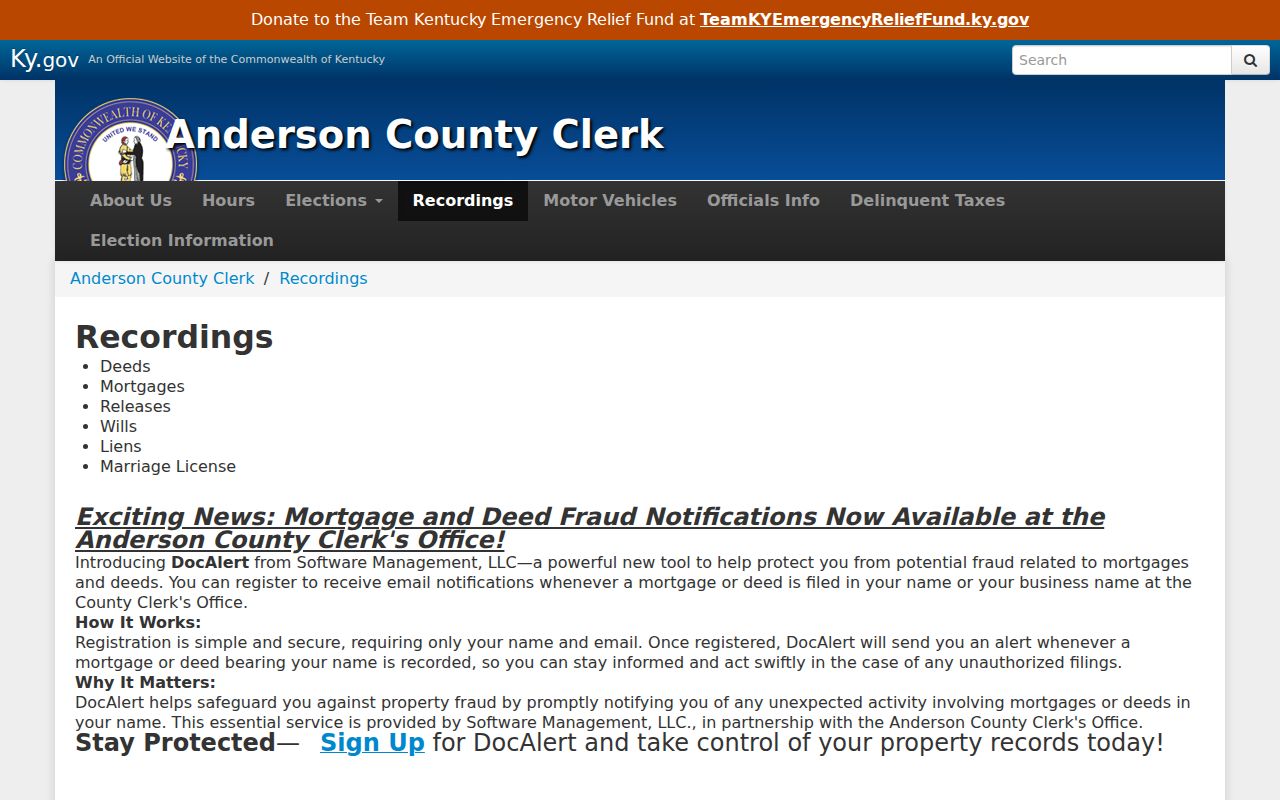
The clerk remains the custodian of record. The online portal is only one route, and the official pages publish no first-online year, no imaging cutover date, and no complete field list. Do not assume every old deed image is online. Track each query before spending a daily search. Five go fast when names vary. Move to the counter or a historical collection when the portal does not reach the needed period.
Note: The clerk's drive-through handles some county business, but the office states that recordings cannot be processed through that window.
Trace Anderson County Deeds Back
Anderson County deeds are indexed by parties. The grantor conveys an interest, often the seller. The grantee receives it, often the buyer. A chain of title links each conveyance to the one before it in an ordered run of instruments. Start with a known current owner or a deed reference recovered from the PVA record.
- Search the known owner as grantee and narrow by a sound date range. Open the likely acquisition deed.
- Copy the grantor's name, recording date, deed type, legal description, and book/page or document reference exactly.
- Search that grantor as a grantee to find how the grantor acquired the same tract. Match the land, not just the name.
- Repeat until the web index ends. Take the last sound reference to the clerk or library for older books.
- Grantor
- The person or entity giving up the stated property interest.
- Grantee
- The person or entity receiving that interest.
- Chain of title
- The linked sequence of conveyances affecting the same land.
- Book and page
- A volume-and-page citation to a recorded item.
- Instrument number
- A unique recording identifier used for a filed document.
Names are clues, not conclusions. Initials, married surnames, trusts, estates, and business entities can change how the same party appears in the index. Compare source of title and description at each link. For an address-to-owner start, try the Anderson County property search workflow before entering the deed chain.
Read an Anderson Deed Entry
Treat any index result as a route to the instrument itself. Record the grantor and grantee spellings. Add the document type, recording date, and any book/page or instrument number the system supplies. Then inspect the image or request a copy. eCCLIX publishes no stable field inventory, so presume nothing beyond those core deed-index elements.
Kentucky's deed rules add context. Under KRS 382.135, instruments in covered situations carry a statement of consideration or market value and mailing or in-care-of information, subject to statutory exceptions. A stated figure is not always a sale price. Gifts, nominal consideration, court transfers, and exempt instruments can produce a zero or non-market amount.
Match the tract through its legal description. A short index line can omit reservations, easements, mineral language, or exceptions that appear in the recorded pages. The PVA sales field may help compare dates. Read the deed before calling a figure sale value.
Plats Support Anderson County Deeds
Deeds describe lots by subdivision, block, and plat reference. Others use metes and bounds. A plat is a recorded drawing that divides or depicts land, showing lots, streets, easements, and survey information. The deed conveys the interest. The plat gives the geometry that deed names. Neither a portal map nor a tax description should replace the recorded source.
Lawrenceburg records carry useful historic terms. Official annexation material mentions corridors such as Broadway Street, Ripy Avenue, Johnson Street, U.S. 127, U.S. 62, and Kentucky Highway 44. It also names the Highlands, Hill-n-Dale, and Witherspoon Subdivision Phase 3 in specific historical entries. Those names can guide an index search. Only the matching deed and plat establish that a tract belongs to the named phase or block.
When a parcel was split or combined, note old and new parcel numbers, deed citations, and plat references. Identifiers change; the land description is the continuity check.
Anderson Deed Books Reach 1795
The Anderson Public Library History Room holds the strongest offline resource around for early land chains. Its microfilm collection includes deeds, marriage records, and tax bonds reaching back to 1795. The census microfilm starts in 1830. The Anderson News is available from 1894. Family files, photographs, and yearbooks round out the holdings. They serve anyone tracing an old Anderson County tract.
Work backward from the newest verified deed. Bring staff the last book, page, party, and tract clue found in the clerk's index. Save every reel or volume identifier alongside each transcription. Newspaper legal notices sometimes surface an estate sale, subdivision, road change, or court action. Treat each notice as a lead only. Confirm it against the deed book, plat, tax bond, or court file first. Rely on it only after that check.
No courthouse fire or lost-record episode appears in any official account of Anderson County. The clerk's online cutoff is likewise undocumented. A responsible property records trail states those gaps plainly. It then leans on the microfilm that does survive.
Estate Transfers in Anderson Records
Wills appear among the recording categories the Anderson County Clerk lists. An estate transfer often ties to a case file kept by the Circuit Court Clerk. So a clean sale-to-sale pattern can pause at a death, a commissioner's action, or a fiduciary conveyance. Read the authority stated in the deed. Follow its case, will, or prior-deed reference to the source.
Guest CourtNet can help locate a party and case number. The Kentucky Court of Justice notes that the file itself comes from the clerk that heard the matter. The court-record request instructions explain that local-clerk route. For Anderson County cases, the Circuit Court Clerk sits at 151 South Main Street in Lawrenceburg, reachable at 502-839-3508.
A court case can explain why a deed exists. It never replaces the recorded conveyance itself. Keep the case number beside the deed citation. The two sources stay distinct.
DocAlert Watches Anderson Filings
The clerk's recording page promotes DocAlert for deed and mortgage activity in Anderson County. Enrollment takes a person or business name plus an email address. When a matching name is recorded, the service sends an email. Think of it as a watch tool for unexpected filings. It does not block anything, and it does not prove fraud.
Name matching has limits. Add every relevant name form the service permits. Review each alert against the recorded instrument itself. Call the clerk through its published contact information if a filing looks unfamiliar. Never pay an unsolicited sender that merely claims to monitor land records.
Note: An alert prompts you to inspect the new recording; it does not determine whether an Anderson County deed is valid.
Obtain an Anderson County Deed
Start with the online image if eCCLIX makes it available. If not, contact the Anderson County Clerk at 100 South Main Street, Lawrenceburg, Kentucky 40342, by phone at 502-839-3041, or by email at CountyClerkAnderson@ky.gov. Supply the names, an approximate date, the document type, and the best book/page or instrument reference you have. Ask whether a plain or certified copy suits your intended use. Ask the current charge too.
The clerk publishes no Anderson County deed-copy fee. No official mail form or online-image price appears either. Confirm cost and delivery method with the clerk rather than a third-party offer. Kentucky law recognizes certified-copy provisions, but certification is a clerk service.
Recorded is not guaranteed. Anderson County deed records show instruments accepted for record. They are not a title opinion, and unrecorded interests may exist. Use qualified legal and survey help when ownership or boundaries must be resolved.