
Find Who Owns an Anderson County Property
Two offices split the work. The Anderson County PVA links an address to a parcel and a likely owner. The Anderson County Clerk's eCCLIX land index then confirms the deed that actually transferred title. Use the first to identify, the second to verify.
- Search the situs address in the Anderson County PVA qPublic system. Save the parcel identifier and displayed owner name.
- Search that owner as grantee in the Anderson eCCLIX land-record route. Open the newest deed tied to the same legal description or parcel clue.
- Compare the grantee, recording date, source-of-title reference, and legal description. A recent deed may precede the next PVA update.
- If the grantee is an entity, use Kentucky Secretary of State records for its legal name, status, agent, and available officers, while recognizing that an agent is not necessarily the beneficial owner.
Note: Anderson citizen eCCLIX access is free for five Anderson-only searches per day; commercial access uses a subscription.
Where Anderson County Ownership Names Appear
Every record type answers a different question. The PVA owner field gives the name used for assessment. A deed names the grantee who received the recorded conveyance. GIS maps supply the geographic setting. Business filings reveal who stands behind an LLC or corporation named in a land record.
| Source | Owner Info It Gives | Access |
|---|---|---|
| Anderson PVA roll | Owner of record, mailing address, situs, parcel and assessment context | qPublic or PVA counter |
| County Clerk deed index | Latest recorded grantee, document date, book/page or instrument reference | eCCLIX or Clerk counter |
| Kentucky Secretary of State | Entity name, organization number, status, agent, and available officers | Free state searches |
| Kentucky GIS resources | Map location and geographic cross-check, not title | KyGeoNet and KGSGeoPortal |
Be careful with names. An occupant might be a caretaker, a relative, or some other lawful user of the land. Occupants are rarely the grantee. The tax bill mailing address can differ from the situs address too. Treat the owner of record as a lead for document research. Never treat it as proof of who lives there.
Read the Anderson PVA Owner Field First
The official Anderson County PVA page sends property searches to qPublic. It lists the office at 101 Ollie Bowen Street, Lawrenceburg, with phone 502-839-4061. The portal offers owner, address, and parcel searching. Save the owner field and the parcel key together. A name alone can match more than one tract. Open the Anderson PVA landing page to start the lookup.
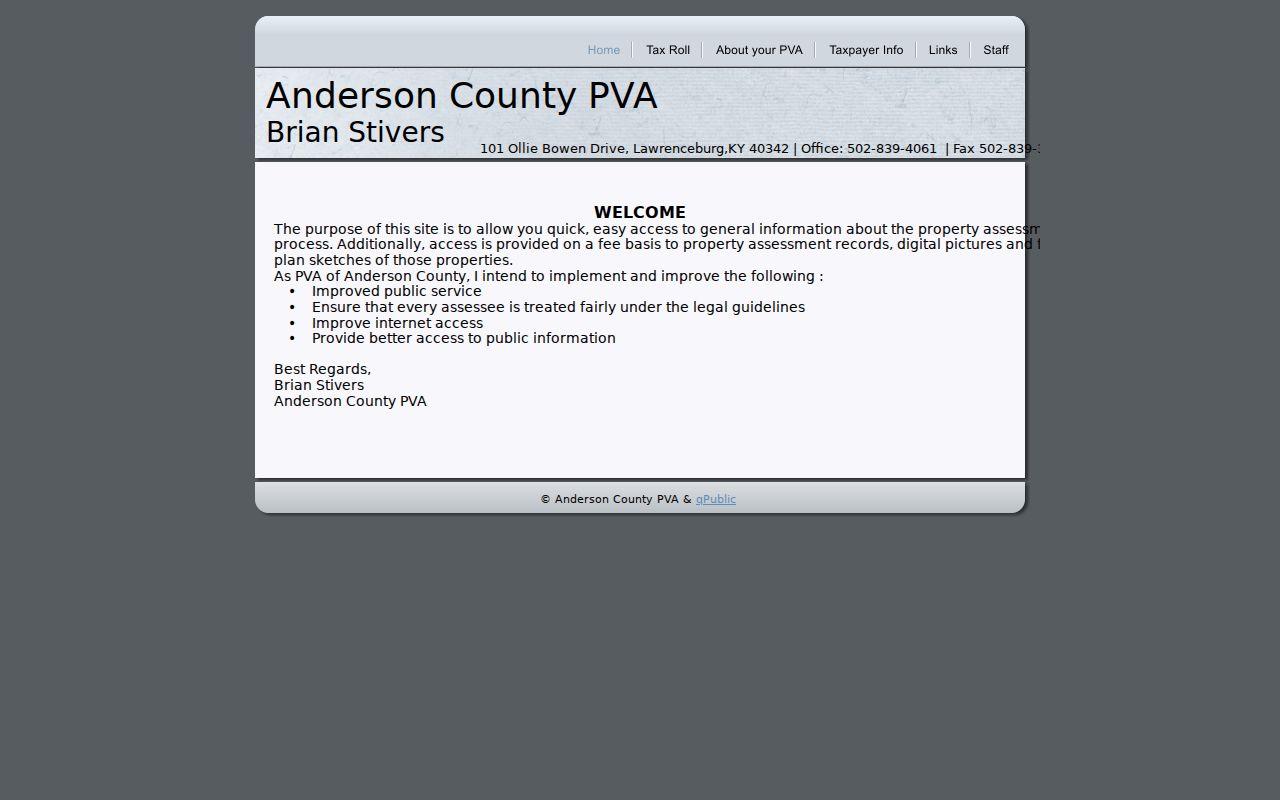
The PVA route is the fastest assessment path in the county. Pair the owner name with the parcel number every time.
Confirm the Anderson Owner on the Latest Deed
The Anderson County Clerk recording page lists deeds, mortgages, releases, wills, liens, and plats and points users to eCCLIX. Run the PVA name as a grantee search there. Then open the newest deed that matches the land. The grantee receives the interest; the grantor conveys it. Review the Clerk's official recording categories before you search.
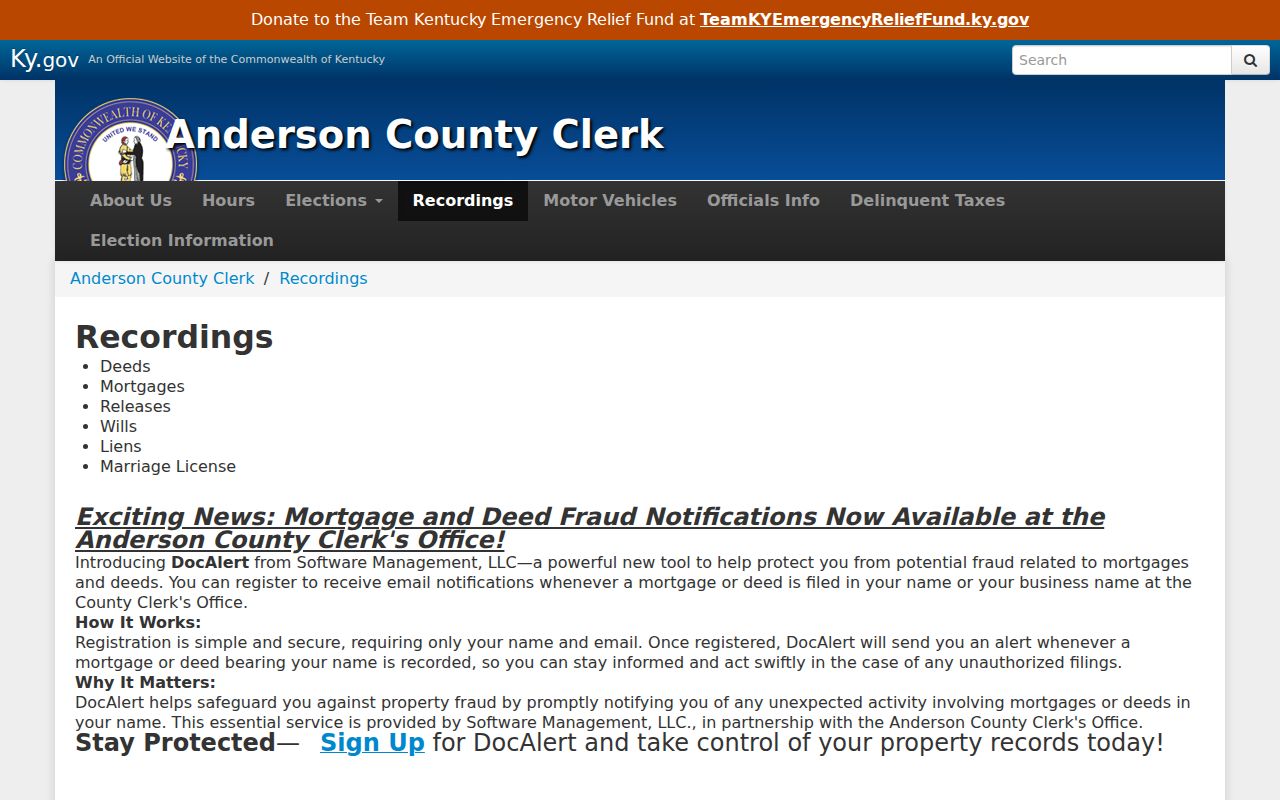
The Clerk is the recording custodian, not a title examiner. Recording alone supplies no title opinion. Read the instrument and its legal description yourself.
Anderson Ownership Terms That Prevent Mix-Ups
Several ownership terms sound nearly alike but do different jobs. Telling them apart is the heart of any Anderson County property search.
- Owner of record
- The name carried on an official roll for its administrative purpose.
- Grantee
- The party receiving the interest described by a recorded deed.
- Situs address
- The location assigned to the property itself.
- Mailing address
- The place used to send tax or assessment correspondence.
- Title
- The legal ownership interest, which a simple index or parcel card does not independently prove.
Trace an LLC Owner Through Kentucky Filings
When the deed or PVA parcel lists an LLC or corporation, plug the exact entity name into the Kentucky business database. Search by name or organization number. Clear the "active only" filter if an older or inactive entity matters. Results can include legal name, number, status, formation date, registered agent, principal office, officers or managers, and annual reports. Use the state entity search to identify who stands behind the deed.
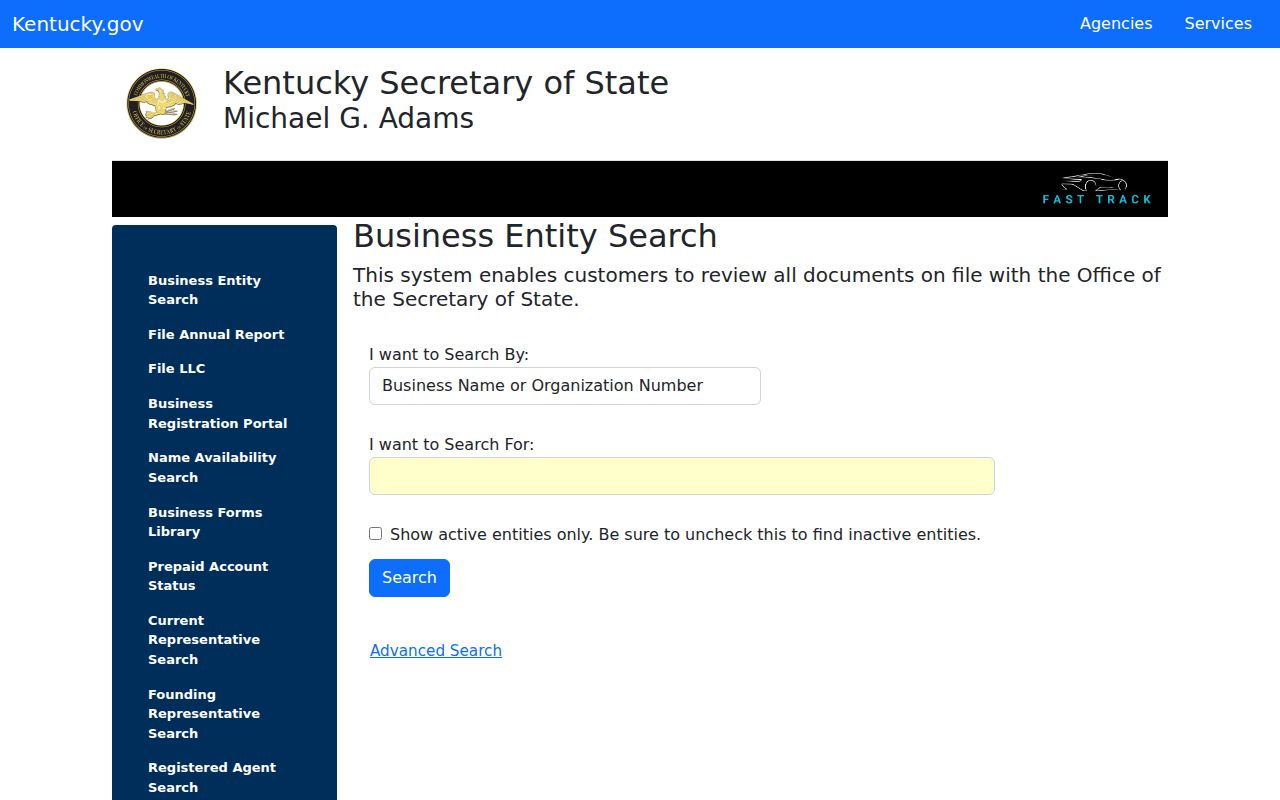
A registered agent is a service contact. It is not automatic proof of who benefits from the land. Keep the entity result beside the deed, never in place of it.
Note: Scanned Kentucky business filings on or after September 15, 2004 are available as images; earlier filings require a separate release route.
Resolve Estate and Trust Names in Anderson Records
Estate, trustee, executor, and fiduciary labels often demand more than a parcel lookup. Start with the County Clerk's deeds and wills. A probate, partition, foreclosure, or quiet-title case might explain the transfer. In that case, turn to Anderson Circuit Court Clerk records. CourtNet can surface a party and case number. The hearing clerk still holds the actual case file.
Older chains lead elsewhere. The Anderson Public Library History Room keeps deeds, marriage records, and tax bonds on microfilm. That collection reaches back to 1795. It can name a prior family or farm. Any ownership conclusion still needs the County Clerk's recorded land records to confirm it.
When the Anderson Tax Roll Lags a Closing
Kentucky law requires a physical inspection. Every parcel must be inspected at least once every four years. Anderson County publishes no fixed timeline for owner updates. A fresh deed can easily be newer than the name on the assessment roll. So compare the recording date with the assessment date. Do not guess at a lag.
For current details, use the current property owner lookup. To rebuild older ownership, follow the separate previous owners deed-chain route. The method here ends once the likely owner and the latest recorded grantee agree.
Safe at Home Does Not Hide Real Estate
Kentucky Safe at Home can substitute addresses and mask information across many state and local functions. Real estate is different. The program's official compliance guidance expressly excludes real-estate holdings, so enrollment does not erase an Anderson County deed or PVA parcel.
Public records still call for restraint. Limit collection and republication to a lawful property need. Never infer identity from an occupant, expose private contact details, or use ownership data to stalk or harass anyone.
Fallbacks for an Anderson County Property Owner Search
When a portal fails, the owner-finding method still works. Start with the PVA office at 101 Ollie Bowen Street in Lawrenceburg, or call 502-839-4061 with the situs address and any parcel clue. Ask how to inspect the public assessment record. Ask too how the office tells a mailing address apart from the property location. If the address is incomplete, bring the road name, a nearby intersection, the subdivision or tract description, and the name printed on a tax notice.
Once the PVA hands over a parcel identifier or deed reference, carry that key to the Anderson County Clerk at 100 South Main Street. The Clerk can explain access to the recording index and to older land records whenever eCCLIX returns nothing usable. Recordings are not handled through the drive-through. Confirm counter procedures before an in-person trip. A written open-records request can work when you can describe one specific public record, though the request should name the record itself rather than ask the office to decide who owns it.
The fallback order never changes. Identify the parcel first. Read the administrative owner name second. Then test that name against the newest recorded conveyance. A phone answer, a map label, or a mailing line is only a lead; it never replaces the underlying PVA entry and deed.
Match Anderson County Property Owner Identifiers
Keep a small workpad as you go. List the situs address, parcel ID, PVA owner spelling, mailing line, deed reference, grantee, recording date, and any legal-description clue, since one surname often covers several parcels or one person owns several tracts. Compare the identifiers as a set. A matching name alone is never the answer.
Rural land often resists street numbers. Acreage, road calls, adjoining-owner language, and source-of-title references can matter more than any street number. For a platted lot, note the subdivision, lot, and plat citation. A PVA name that clashes with the newest grantee leaves the result unresolved. Ask the custodians about timing or parcel identity. The goal is a supported owner finding, not two records forced to agree.
Limits of “Who Owns This Anderson Property”
A public lookup proves paper ownership only. It cannot confirm possession, occupancy, or identity. A deed index is just an index. Liens, estates, trusts, court orders, boundary disputes, and instruments outside a name search can all change the answer. Before a purchase or any serious title issue, pull the underlying records and get qualified Kentucky legal advice.
Lawful use. Anderson County owner records support due diligence, estate work, and property history. Never use them to stalk, harass, intimidate, or harm anyone.